Wednesday, 28 March 2012

Feathered Friends— The Sequel


Back to the South Island we went just a few weeks ago to explore the southern section of the island, beaches, headlands, fiords and mountains— Aotearoa is never lacking for amazing places. Sure enough we “happened” upon a few more feathered friends.


Yellow Eyed Penguins… When I figured out there were penguins in New Zealand, it was a no brainer because I never envision making it to Antarctica— this was the one shot. The yellow eyed penguins are endangered, the rarest of all penguins. We figured out from the guidebooks that if you are at particular beaches an hour before sunset, that’s when the penguins tend to come ashore to feed their chicks, who hang out at the nest in the deep bush just off the shore or beach. So we turned up hoping we might catch a glimpse of a penguin running across the rocky ledges to the bush. Wrong again, there were about fifty people standing on the ledges when we arrived and there was a penguin ten meters away preening himself/herself with oil from its oil gland to keep the feathers in ship shape for tomorrow’s swimming. A Department of Conservation volunteer was on hand to monitor the people who tended to creep closer, though the penguin seemed unbothered. 


A couple of more penguins turned up out of the sea and then a “chick” waddled down from the bush hoping that a parent was going to come up and provide a regurgitated fish meal. In fact the chick was nearly the size of the adult and most of the chicks had left, but not this character (a bit on the slothful side I guess). But alas, none of the adults made a move for the chick so back in the bush went the chick. The volunteer said the chick might get a feed later or the parents may have been communicating tough love— time for the chick to get out and fish for itself.

The chick says... "Where's my supper?"

Two days later we headed up the coast to a penguin rehabilitation and research centre and protected area. It was pretty neat. We got a talk on penguin behaviour and then a tour (five of us) out into the protected area where they have visitor blinds so that folks do not disturb the penguins. All the chicks had left and the penguins there were molting, which happens one month a year. During this time the penguins have to stay on land and don’t eat. Our highlight was watching a penguin pop out of the waves and scurry up the beach into the grass… I could not believe how fast a penguin can move on land when it wants too. Very cute!
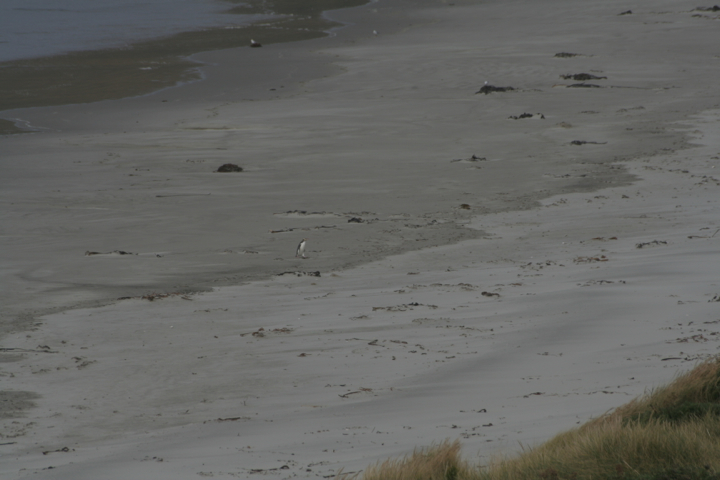
Who can you see on the beach?

While waiting for our tour at Penguin Place, we had some time to waste and we heard you could see albatrosses flying from the parking lot of the Royal Albatross Centre without even paying for the tour. Well it did not take long to see them soaring with their 9 foot wingspans. So then we figured we would check out the free museum displays… excellent… so they had us and off we went on the tour to see the albatross chicks on the nests, with parents dropping in and out to feed them. Again their was a glassed in blind so as not to disturb the birds. You have to say the chicks are cute!


It takes them nine months to leave the nest during which time they grow huge to the point that at the end the parents put them on a diet or else they wont be able to fly (they get fatter than their parents).
Even at the size of the one in the picture, the arents n longer can sit n them. Once they are ready to fly and lift off the cliff for the first time, they do not return to land for 5 years (!), circumnavigating the globe in the Southern Ocean across that time. It was amazing to watch them soar through the air.

Albatrosses are diminishing in numbers and 18 species are threatened at one level or another, all the way to endangered. The main problem is fishing boats as the birds are attracted to the fish waste, fish nets and bait hooks and in the process get caught by the hooks or nets as they go over the side. Several organizations are working hard to educate fishermen as there are a bunch of fishing techniques that reduce bird mortality. Seabird Solutions is leading the battle in New Zealand. They are having some success educating fisherman, but the illegal fishery, largely in international waters, is really damaging and accounts for 30% of all fish catches.  That is not a pretty picture. The birds are indeed amazing, well worth protecting.


Sunday, 5 February 2012

History is Written by the Victors!

Since we have been here a good while, we are learning more and more about where to go to find the cool places off the beaten track. The last two holiday weekends (two Mondays off in the summer in succession… not bad) we have headed out tramping to magnificent places where the marketers have not been (nor lots of other people).


This weekend we went to Pureora, which came to our attention as it was the flash point in the 1970s for environmental protest across New Zealand against the destruction and clearcutting of native forests by the big companies. It is NZ’s equivalent to Clayoquoit Sound in BC or the tree sitting in Northern California. People protested and sat in trees to protect some of the biggest remnants in the area that were about to be cut. Only… in this case they won. They protected these trees and over the next decade pressure built and ultimately a national law was passed preventing all future cutting of native forests. The companies are still cutting and replanting the areas previously cut (agriforestry) but all existed native forests are protected… about 30% of New Zealand.


So I am not sure if you can read the fine print, but here are two NZ Department of Conservation interpretive signs heralding the protests and the end of clearcutting. I love the picture on the 2nd sign of the big machinery destroying the forest, and this quote from it… “all this activity [destruction due to forestry practices] has left us with the diverse and fragmented landscapes of Pureora. The work of restoring some continuity to these forests and re-establishing healthy wildlife communities is the challenge for today and the future.” Wow… you would not see these sorts of signs in Canada. In fact the current history of our forests seems to be written by Irving in their greenwash TV ads. This shows there is another way and at least some folks in the world have found it…. oh and by the way the rural economy in New Zealand is not in shambles, it has not been destroyed by the logging ban, though the loggers at the time would have had you believe it. Hmmm.
This is looking up at a tree from the ground

    A wonderful trail infrastructure preserves the forest

                                                                                  Forest Regeneration

So here are a few more pictures from the weekend travels. Ginny goes "Kiwi"...

    This is the Kiwi hiking top, but where are your tan khaki shorts?

Good Kiwi hiking form... hiking up a 
stream "trail" with her hiking boots on.

Lake Taupo from the Umukarikari Ridge. Lake Taupo is the crater of the
largest volcano to blow in recorded human history (186AD). Both Rome
and China had it documented in their records based on red sunsets and
climate cooling.

Thursday, 2 February 2012

Are you doing any work?

So everybody is always asking me… “Are you doing any work?” So now you get your just desserts… having to read a blog about work… It is just that it seems more fun and interesting to write about the latest wilderness tramp or eco marvel than the latest section of a food policy paper. But… I did get to go to the New Zealand Environmental Education Conference two weeks ago, which was excellent, and since a number of the folks reading this blog are generally interested in sustainability, community and/or education… here are some of the best things I harvested at the conference for your learning pleasure. Sorry, no pictures.

Enviroschools (www.enviroschools.org.nz)
Enviroschools is a pretty amazing NGO that is taking a whole school approach to education for sustainability. It pretty well dominates sustainability approaches in schools in NZ. More than 25% of the schools in New Zealand are enviroschools and working toward bronze, silver or green gold status. What is so neat is that this is a very reflective, philosophy based and student centred process of working for sustainability. Everything done in an Enviroschool is to be anchored in 5 principles:
  • Empowered Students: Enable the development of skills, knowledge, confidence and experience to contribute to their communities.
  • Integrate Māori perspectives.
  • Learning for Sustainability:
  • Sustainable Communities: Connect children and young people/tamariki and rangatahi to contribute to their communities.
  • Respect for the diversity of people and cultures in our communities and world.

These principles must be enacted in four areas… involving everyone (kids, teachers, janitors, parents, community, etc.), greening of the place, greening of the curriculum experiences, and the lifestyle practices (composting, water use). How exactly the school takes the principles and applies them in the areas is up to them, but there is a rigourous self-assessment process involving interacting with an external facilitator. Ultimately the kids decide after working through an evidence based process on what they have done. Each school has to have a lead student group. Anyway, it is pretty neat and very different to the activity package, tick the box approaches in Canada. I am going to spend some time with the staff in the next few weeks, visit some schools and bring home some of the resources. I am going to buy the toolkit which is amazing in that the activities and concepts apply all the way from preschool to university (and it is a beautiful artistic presentation). Lots of great community development, empowerment, facilitation activity ideas. They also have the script we can use for next year’s solstice play (with a few adaptations)!

Steady State Economy (steadystate.org)
The concept that at the core of all our sustainability problems is that we have a world economy based on growth in a limited biosphere, which cannot support it. These are economists defining and developing ways to change the fundamental assumptions to bring about a steady state economy. There’s lots here but the briefing papers are most accessible under “Explore.”

Education for Sustainability and Environmental Education in Schools
http://seniorsecondary.tki.org.nz/Social-sciences/Education-for-sustainability
FYI here is the link to the New Zealand Depart of Education’s curriculum website on Education for Sustainability. It is funny how NS has no equivalent nor really ever pays anything more than mild lip service to Education for Sustainability in its curriculum and curriculum guidelines. Though dated, NZ also has Environmental Education curriculum guidelines: http://efs.tki.org.nz/Curriculum-resources-and-tools/Environmental-Education-Guidelines. The NZ school curriculum is about 50 pages whereas in Nova Scotia every high school course is about 50 pages, covering all levels. If you added all of the NS Curriculum documents together you would have at least 1000 pages, 20 times what New Zealand has. That sends a very different message about the role of the teacher and the concept of education in schools. The vision statement for the NZ Curriculum is:

"Our vision is for young people:
  • who will be creative, energetic, and enterprising
  • who will seize the opportunities offered by new knowledge and technologies to secure a sustainable social, cultural, economic, and environmental future for our country
  • who will work to create an Aotearoa New Zealand in which Māori and Pākehā recognise each other as full Treaty partners, and in which all cultures are valued for the contributions they bring
  • who, in their school years, will continue to develop the values, knowledge, and competencies that will enable them to live full and satisfying lives
  • who will be confident, connected, actively involved, and lifelong learners.


 P.S. I tried to google the NS one to compare and could not easily find anything, just documents for each course or topic. Hmmm?

Design Thinking
(candychang.com)
This was an excellent talk on being innovation in the design of programming and community development initiatives. Design thinking is briefly… don’t plan much. Do some intensive framing up and research on the issues to define the question, then pull people together, brainstorm and then go try stuff and learn from failure and reflection. The idea is that folks get bogged down in long committee processes that stifle innovation… collect wild ideas, try the best ones quick and dirty and then revamp. The one liner is… “to succeed more, we need to fail more.” Some of the info is on the ideo websites. Candy Chang is an urban designer who has done a bunch of creative projects to get community members connecting to each other. Her website pictures a few of them

Saturday, 21 January 2012

The Fledglings of Birds

Some folks may have seen Children of Men, an excellent movie set in the future when a section of England is the only place on earth still protected from the violence of the hordes and the ravages of climate change across the rest of planet earth. In the movie there is a huge fence to protect the last privileged humans...


So today we visited the Maungatautari Ecological Island (meaning suspended mountain or mountain of upright rock in Maori), an ancient volcano thrusting skyward in the middle of the pastureland of the Waikato, not far from Hamilton. Maungatautari is a parallel universe to Children of Men, only the hordes are the invasive mammals on the outside and the endangered species of New Zealand birds are the privileged on the inside. To protect the birds there are 47 kms of enormous metal fence (8500 3-metre metal fence posts), which resembles a fence that surrounds a maximum security prison. The holes in the fence are no more than 6 mm wide, because a baby mouse is 8 mm. Below ground the fence forms an L, 3 metres high and going a metre horizontal underground on the outside to stop digging rodents. On the outside top is a reverse overhang to stop climbers. On the very top is a solar electric wire so that if a tree falls on the wire, it shorts and automatically sends a text to the fence security person saying the fence integrity has been compromised. Security has 90 minutes to respond as video cameras along the fence line show there is an invasive mammal trying to get in every 90 minutes on average (possum, rat, stoat, ferret, etc.).


Given all of this, the 3400 hectare forested volcano is pest (mammal) free except for small populations of mice. As the result, the forests are exploding with growth and they have reintroduced populations of endangered birds that are now breeding. In a couple of cases there is only one other place in the wild where this is occurring for these species. We saw a Hihi today, of which there are believed to be only about 250 alive. They have 40 Kiwi and there were 10 new chicks this spring (your fall). Also there are a number of Kaka, an endangered North Island parrot and close relative of the Kea, the South Island mountain parrot, which is believed to be the smartest bird on earth. It is quite magical to enter through the security fence. To enter from the wide-open car park and field area, first, push a button and the metal door opens into the biosecurity holding cage. Shut the first door and you can push the button to open the second door that allows you to leave the holding cage and enter the dark rainforest full of multitudes of different plant species and birds. It is a world of pre-European contact.

 A Kaka at a feeding station (sorry, I missed the Hihi with the camera)

So what does this all mean? It is unbelievable that a non-profit organization has raised more than 20 million dollars to protect and restore this huge, magical place, and admission is free! It is an amazing tribute to what people (Pakeha and Maori) can accomplish to protect and restore nature.

               Stairway to Heaven (the Tree Tops)

                                              Looking down into the treetops (these are large trees)

There are hundreds of volunteers and an amazing human story behind it all, with both great ups and downs, full of passion, charisma, hope, faith, injustice and malevolence (that human/community story is too long and complicated to tell here). This is a dramatic feature film waiting for a filmmaker (Evan?). Shall we call it the Fledglings of Birds? Of course then one has to scratch one’s head and think that all this has to be done to protect an ecological island against the idiocy of colonialism and human stupidity. The mammals are here because the British purposefully brought them. They felt that Aotearoa was uncivilized and undeveloped. It needed to have mammals to be more like “home”… hmm, now is it coincidental that in Children of Men the last bastion of a “civilized” and privileged lifestyle was protected behind metal fences in England?

P.S. To learn more about Maungatautari, check out www.maungatrust.org. Read the news links on the recent introduction of North Island Robins and Kokaka.

One of hundreds of volunteers showing off a mouse tracking sheet 
which monitors population size. The tracking ink sheet goes in a 
dark tube with bait and the mice run through to get the food. 
Population estimates are based on the percent of tubes tramped 
through on a given night

Saturday, 7 January 2012

You've Got to Love the Huts!

The forecast was iffy, and the sky was outright drippy, when we set out off to Angelus Hut above the beautiful Nelson Lakes, South Island in mid November. A steep uphill slog for the first two hours or so, up through an increasingly thick but short beech forest. Mist swirling and dripping a heavily on us, our view of the lake below disappeared and then the rain set in. No worries, we ducked into a handy little rock shelter at the tree line, had lunch and waited. 
Luck was with us, for the rain finally stopped and we set off across a huge ridge when out of the mist ahead emerged two friendly Kiwis who were just leaving an old dilapidated ski hut which had been a popular winter attraction years ago. It used to have a rope tow but that had been taken out years ago. The rope tow was handy in the old days because after hiking two hours up the steep incline  up to the ski hut through the snow, carrying their skis, the skiers were understandably tired, and really appointed the luxury of a rope tow! The neat thing was that a community group had just purchased the old building, and were renovating it into a shelter for school groups to use as they tramped in the mountains. They had just helicoptered in a new septic tank and a small bulldozer to do some site work...No big deal. Just a fun day volunteering their time to help kids learn to appreciate their natural world. New Zealanders love the outdoors, and the kids do too!


We tramped in and out of the mist with less and less visibility, knowing that we were missing some pretty spectacular views. Oh well, maybe we would see them next day. Mist turned to rain, and the next two hours were wet, wet, wet. Our feet were soaked because in addition to the rain, we we walking above the snow line in last year's snow and it was drenched. Finally we crested the ridge, and saw below a cute little hut. A half hour later we were inside, hanging up our wet clothes above a cute little wood stove, chatting with the rest of the trampers there. There were about 11 others at the hut. Three New Zealanders, three from Austria, five  or six from Australia. 

Oh I should explain the hut system. There are probably hundreds of huts throughout the country owned and run by the Dept of Conservation. They cost anywhere from five -thirty-five dollars per person  per night. Most of the huts are  unattended, so it is all on the honour system. You put your chits in a little metal box and make yourself at home. There is a a great space for cooking, big tables for communal eating, and then usually 1-2 separate dorm rooms for sleeping. The dorms have huge bunk beds, with each level of the bunk able to sleep 8-10 people or so. There are mattresses on the bunks, so all you need is a sleeping bag. Well, sometimes it helps to have ear plugs, because some people snore, but if you are tired enough, it does not bother you to be sleeping on the top bunk next to several other strangers sawing logs in their sleep.
The toilet facilities are outdoors, this time they were up a very muddy hill on a really windy knoll above the hut. Sturdy little port-a-potties bolted to the rocks.  They  are helicoptered out and replaced as necessary! Water? The water is collected via a sophisticated system of eave troughs which drain into huge tanks next to the huts. The water drains into the sinks by gravity, and they never run out of water because it rains so much!
The only rule about the huts is that you need to keep them clean and tidy, with counters cleaned, and floors swept each day so the next batch of trampers can enjoy them.  And believe me there will be trampers every day, regardless of the weather. Does the hut system work? Yes! Everyone pays their little chits into the box, and they dutifully clean the hut before leaving. Quite a remarkable system. If you want to tent, instead of sleeping inside, the fee is about half the hut fee, and you get to use the cooking space, toilets, water etc. This trip we chose the hut because there was still 3-4 feet of snow around the hut, and tenting would have been too wet (never mind the fact that it was raining!)


Great company with the other trampers that night and the next, and a welcome sky which cleared that  night, giving us  a lovely couple of days more. The views on the return were incredible, well worth the wait. Thank you New Zealand and New Zealanders for having such incredibly good hut and trail systems.


Sunday, 25 December 2011

Happy New Year


WarPo Productions releases its first blockbuster film, "Exploring Aotearoa/New Zealand," just in time for the Solstice/Xmas season. As VIP audience members, you have been given free viewing rights to this epic story. Here are some of the initial reviews...

"This puts Peter Jackson to shame, his Middle Earth does not compare. This is a shoo-in for an oscar. And of course I like the idea of having a more equal role relative to those dreadful hobbits."
— Gollum

" There are some pretty stunning roots and trunks in here, but the Kauri are a bit stocky if you ask me. I am nominating myself for "best looking flora in an action adventure story."
— Treebeard the Ent

To download and view this stunning new masterpiece, right click (or control click on the link below). It will download to your regular download locale. It will take a couple of hours, plus or minus depending on the speed of your internet. It is about 700 mb, 25% of the size of a feature film. Once it is done, double click to watch it.  Watch it in full screen with good audio.


Wednesday, 7 December 2011

Feathered Friends

There are no native mammals in New Zealand, though sadly a number of introduced species (possums, stoats, rats, etc.) have been wreaking havoc in the forests and killing birds and eating their eggs. Still, big efforts are being made to control their populations and they are mostly nocturnal. You rarely see mammals in the day. But there are lots of wonderful and unique birds. Here are some of the pictures we have taken with a little insight into our view of them (anthropomorphasized of course). A number of these pictures were taken on a wonderful day in which we rented kayaks and headed out into the Okorito Swamp, the largest coastal estuary in New Zealand on the west coast of the South Island. It was a spectacular day with the Southern Alps in the background. We wandered from the outlet through the mud flats and up into the rainforest.


Tui: “I am New Zealand!”
Wherever and whenever I hear the Tui (the bizarre and beautiful series of calls that sound like a happy creaky rusty iron gate closing), I will think of New Zealand. A friendly, beautiful bird that flits about sucking nectar from flowering trees (this is the one web picture as despite seeing lots of Tuis, we have no good photo of one. Everything else below is one of our photos.)


Spoonbills: Dressed to Kill
Watching spoonbills siphon mud through their bills is like watching the avian version of a guy on a beach with a metal detector searching for spare change.


Kototuku (White Heron): The Predator
Sleek, quick and flexible, fish do not stand a chance.


Kea (Mountain Parrot): Major Mischief— the Smart Aleck
Reputedly the smartest bird in the world and smarter than a monkey. When bored, likes to amuse oneself by breaking into cars, destroying rubber objects such as windshield wipers, stealing shiny objects (sunglasses), etc. Very personable and approachable but don’t be fooled!


Torea (Pied Oyster Catcher): The Temperamental Comic
It always takes two to tangle and they are not low key (they hang out in pairs). They will send you a laughable call one moment and “call you out” the next one if you do not get with the plan or get to close.


Red Billed Gull: The Thief
Prettier than some of their cousins, but no less skilled when it comes to food theft.


Parekareka (Spotted Shag): The Sensitive Stylist
They won’t let you close and they show off numbers of elegant positions as they perch and dry their wings.


Kereru (New Zealand Pigeon): Royalty
They love to perch high above you with royal elegance and colours.


Weka: The Rascal
On first blush they resemble a duck, but then they seem like a wild chicken. Oh my, the lengths they will go to as they try and sneak some food from your pot. Persistent, but not the sharpest tack in the pile.


Birds of the Field:
There are lots of little ones flitting about, mostly worried that you could be a threat.


The Moa: Lost and Found
The amazing flightless bird that ruled the land until the Maori wiped them out for food several hundred years ago before the Europeans arrived. We found these in a sculpture garden.